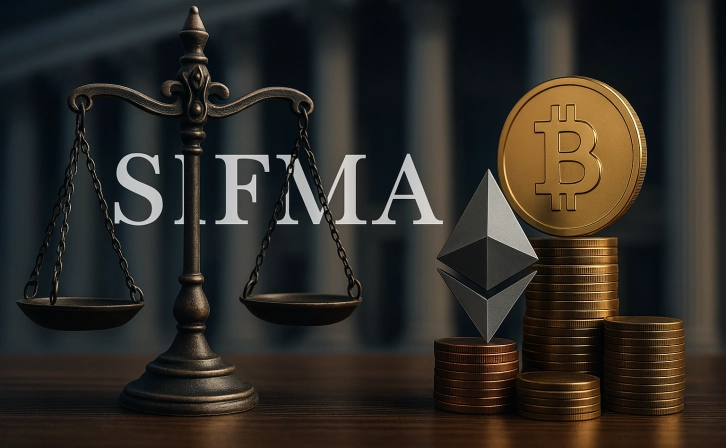
US Senate canceled the defi broker rule

Today, in the crypto world, a new survey conducted by Bitpanda revealed that only 20 %of the banks in Europe provide crypto services despite the investor demand and the regulation clarity in the region.
The US Senate accepted a proposal that canceled the defi broker rule of the Internal Income Service (IRS) and the bill was sent to President Donald Trump, who was expected to sign. On the other hand, the Hyperliquid Stock Exchange, Jelly Token Perpetual Futures due to “suspicious market activities” has been crazy.
The survey conducted by Bitpanda with 10,000 individuals and corporate investors in 13 European countries showed that 40 %of corporate investors have already kept crypto assets, while 18 %plans to invest in the near future.
On the other hand, only 19 %of the financial institutions participating in the survey showed that customers show great interest in crypto products, while this shows that there is a 30 %difference between the real adoption rate of investors and the perceived interest.
Although 80 %of the financial institutions in Europe acknowledge that the importance of crypton has increased, only 19 %actively provides crypto services. However, some European banks begin to realize this demand; 18 %of the financial institutions participating in the survey said they plan to expand their services, especially for crypto transfers.
On March 26, the US Senate voted to cancel an arrangement of the Biden period, which includes the defi protocols to report to IRS. The bill, which was adopted by 70 to 28 votes, was now sent to Donald Trump.
The IRS defi broker rule required the gross revenues of defi platforms such as decentralized stock exchanges to report the gross revenues and the information contained in the transactions.
David Sacks, the White House’s official on artificial intelligence and crypto, said that Trump had previously opposed this regulation and supported his cancellation.
The critics of the rule argued that this would prevent innovation by subjecting defi platforms to unnecessary regulations, while the opposing views suggested that it could create an deficit for tax evasion.
The Senate was expected to pass this law, because in early March, he had accepted a similar proposal. The House of Representatives approved a copy of the bill on 11 March due to the constitutional budget rules.
Blockchain platform Hyperliquid announced that Jelly Token Perpetual Futures processes are delisting because of the detection of “suspicious market activities”.
Hyper Foundation, a non -profit -free organization of Hyperliquid ecosystem, announced that they will compensate for a large part of affected users. Hyperliquid, on March 26 on the X platform on the X platform, “the damages of all users except for the flags will be covered by Hyper Foundation,” he said.
The incident began when an investor opened a large short -6 million -dollar short position on Jelly Token and then liquidated himself by raising the token price on the chain.
If the founder of the web3 company AP Collective, Abhi, Hyperliquid had not closed the position, Jellyjelly Token said that the stock market could be completely liquidated when the market value reached $ 150 million.
Gracy Chen, CEO of Bitget, the crypto exchange, criticized Hyperliquid’s approach to the incident and said that the platform is at risk of being “FTX 2.0 .. Chen suggested that Hyperliquid acted as a central structure despite being introduced as a decentralized stock market.
This brought up concerns about Hyperliquid’s level of decentralization, led by a limited number of confirmants.