
Post-Quantum Cryptography and Blockchain: Preparation Strategies for Future Attacks
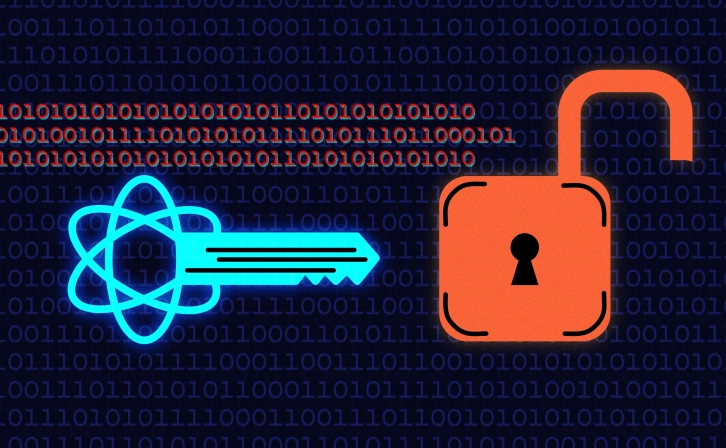
While quantum computers were once only a theoretical concept, they are now advancing rapidly and radically changing our understanding of data processing.
While traditional computers use binary units called bits, quantum computers work with units called qubits. Qubits have the ability to exist in multiple states at once, making them much more efficient than classical computers at solving complex problems.
This development poses a major threat to the blockchain industry. Existing cryptographic systems that provide blockchain security may be compromised by the emergence of quantum computers.
Encryption methods such as Rivest-Shamir-Adleman (RSA) and Elliptic Curve Cryptography (ECC) are widely used in major crypto networks such as Bitcoin and Ethereum. The security of these systems stems from their complexity, and current computers are insufficient to decipher these systems. However, claims that quantum computers can crack these encryption methods may leave blockchain networks vulnerable to attacks previously deemed impossible.
Quantum computers have much more powerful processing capacities than classical computers. For example, a three-digit combination lock has about a thousand combinations and a person can try them one by one. But a 12-character online password has approximately 7212 different permutations, which is impossible for a human to try.
Classical computers can try such passwords sequentially. On the other hand, the possible combinations in a wallet’s encrypted private key increase to 2256, a size beyond the reach of classical computers. However, quantum computers may be capable of solving large numbers of such combinations.
This explains in a simplified way why quantum computers pose a threat to blockchain and cryptocurrencies. Solutions proposed by quantum computers to address these threats are often theoretical or rely on the creation of new, quantum-resistant blockchains.
However, this solution does not seem practical when there are millions of dollars of investments in existing blockchains. Instead, some researchers focus on developing end-to-end frameworks for existing blockchains.
There are also potential threats, such as the fact that quantum computers can be much faster than classical computers in mining blocks, and this can centralize mining power. It’s hard to know how these threats will play out in practice, but the interaction between blockchains and quantum computers could pose new and unexpected problems.
Although the field of quantum cryptography has the potential to break existing encryption systems, it is not yet sufficiently developed for practical applications. Blockchains are constantly evolving to counter quantum threats, and in this process, quantum-resistant encryption methods need to be developed. Currently, quantum hardware is largely a theoretical concept, so there is no immediate threat to existing systems such as Bitcoin and Ethereum.
Among cryptocurrency algorithms with quantum resistance, there are solutions such as SPHINCS+. Additionally, standards organizations such as the IEEE are working to determine best practices for quantum resilient software development. Blockchains may have the ability to change encryption algorithms faster than other industries. Especially chains with a governance structure can make this transition more easily. Chains such as Bitcoin and Ethereum can complete this transition in a longer time.
The transition of blockchains to quantum cryptography will be challenging, and the distribution of the chain may increase this difficulty. During the transition process, it may be necessary to use dual systems to interact with legacy systems and minimize performance impacts. Some blockchains built more recently may be able to more easily integrate quantum-resistant solutions. For example, chains built on the Cosmos SDK may offer a suitable structure for this transition.
Some chains, such as Secret Network and Fhenix, use encryption methods that are resistant to quantum attacks. Although quantum computers have the potential to threaten existing encryption systems, it remains unclear when this technology will fully mature. Although the earliest estimates point to 2035, this date may extend even further, to 2050.