
Bitcoin Lurks: Opportunity or Threat?
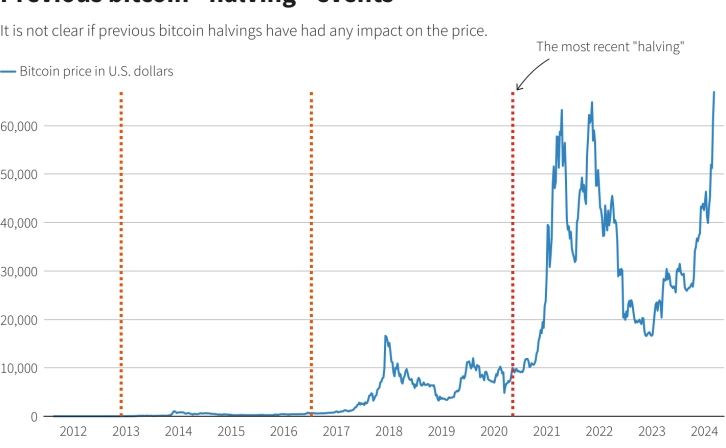
Recent developments such as the conditional approval of Bitcoin and Ether ETFs in Hong Kong and rising tensions in the Middle East are affecting market dynamics. These factors, along with the upcoming halving, play an important role in shaping both investor psychology and Bitcoin's short-term financial landscape.
Hong Kong has taken a significant step forward in the cryptocurrency market by conditionally approving the first spot Bitcoin and Ether ETFs to be offered soon by companies such as subsidiaries of local issuers Harvest Fund Management and Bosera Asset Management. Unlike the cash creation model common in the US, these ETFs will use an in-kind creation approach that allows shares to be issued using actual BTC and ETH. This method increases market liquidity and facilitates ongoing trading.
This initiative could significantly impact Hong Kong’s role in the global digital asset market and encourage broader adoption and investment in cryptocurrencies. With Bitcoin currently trading below $67,000, the upcoming fourth halving event on April 20 has become a focus for analysts and investors. JP Morgan analysts suggest that the market is already adjusting to the halving, according to a February report.
Historically, halvings that reduce miner rewards and adjust mining difficulty have caused supply-driven price fluctuations. Additionally, the U.S. Securities and Exchange Commission (SEC)‘s recent approval of a Spot Bitcoin ETF is expected to increase institutional interest. Meme coin HULVIN rose 44% overnight, reflecting increased retail investor interest ahead of the halving. Due to the volatility of meme coins, caution is advised.
Despite the potential risks, Bitcoin’s stabilizing price and increased institutional investment point to a market ripe for potential gains after the halving. Amid escalating tensions in the Middle East, Bitcoin is facing resistance near $64,000. According to CNBC Crypto World, geopolitical uncertainties are making investors nervous and potentially hindering Bitcoin’s uptrend.
The cryptocurrency community is also keeping a close eye on the upcoming halving event, which occurs every four years and reduces mining rewards. This period of geopolitical instability may lead investors to Bitcoin, which is perceived as a safe haven. Increased market volatility due to these tensions can impact both short-term trading strategies and the overall market mood. Prolonged unrest could undermine investor confidence and limit Bitcoin’s ability to sustain higher prices. Investors continue to exercise caution by closely monitoring developments in the Middle East as they could significantly impact Bitcoin’s price dynamics. Bitcoin (BTC/USD) is currently trading at $62,900, down approximately 0.65%. The pivot point for the cryptocurrency is set at $61,415. If it manages to stay above this level, the upward trend is expected to continue.
However, if it falls below this level, a sharp selling wave may be triggered. Key resistance levels are $64,873, $67,846 and $71,608. On the downside, Bitcoin currently finds support at $58,181. Lower support levels appear at $ 55,649 and $ 52,859. Technical indicators show the Relative Strength Index (RSI) at 33, indicating a potential oversold situation. The 50-day Exponential Moving Average is currently trading at $66,838, indicating that Bitcoin is currently trading below a key moving average indicator.